Categories
Uncategorized

Google Ads

Grow your business with Google Ads 

Google ads are a powerful tool for businesses to achieve their marketing objectives. From growing your brand awareness to increasing website traffic, Google ads provided marketers the ability to show relevant advertisements to a huge volume of prospects. They can accomplish this through multiple advertising channels, including Google search, display, video, shopping and app. Within these channels marketing campaigns can be further optimized by detailed targeting by device, location and more making the platform a robust digital marketing tool. 

Explore the value of Google Search 

With over 3.5 billion searches made each day (Skillshop, 2019), Google search is a valuable tool for businesses wishing to achieve their marketing objectives online. In the Ad search certification course, we learn how these marketing objectives can be set and achieved through Google keyword targeting. Advertisers can choose different combinations of keywords that are likely to be entered by their prospective clients and then enter a bid for placement. If a company has relevance in their keywords and a strong enough bid, they will win the auction and have their advertisements shown over competing advertisers. Google even makes things especially easy for it’s media buyers with dynamic search ads. These ads allow Google’s algorithm to pull in information from a website or landing page and create search ads without extensive keyword research or analytics. This is a feature similar to Facebook’s dynamic ad creative which empowers the algorithm to do the heavy lifting. 

Understand the Google Ads auction 

The goal of any advertiser placing bids with Google is to achieve a strong position at a good price per click. This is achieved through ranking position which is determined through 5 different factors. The amount bid, the ad rank threshold, context of query, ad extension input and auction time and quality are Google’s parameters which are all taken into consideration. For advertisers to improve their performance they need to focus on improving their quality score by showing high quality and relevant content to viewers. This includes on their websites and landing pages.  

Deliver the right message with text ads 

Whenever you search for something using Google’s search engine, you’ll see sponsored advertisements at the top of the search list. These are companies that are leveraging text ads. These text ads contain a headline, URL and description to direct people to their website and acts as the companies “front door” (Skillshop, 2019) of their business on the Google search platform. 

Make ads relevant with search ad extensions 

Customers want a search experience that makes getting the desired information seamless. Google search extensions allow for just this. Advertisers can choose from a variety of extensions to bolt onto their text ads to improve campaign performance. Three highly recommended for all advertisements by Google are their sitelinks, callout, and structured snippets. Depending on the type of business you can add many more including, location, call, app and price.  For example, a local retail business would likely benefit from adding the location extension so people could find their location while a local lawyers office would likely find the call extension useful.

Increase efficiency with automated bidding 

Setting your campaign bidding strategy has a significant impact on your bid for ranking and performance. If you bid too high you may be paying more than necessary but if you bid too low you may not get the conversion result you’re looking for or your ads may not even be shown at all. This can be a time consuming and frustrating task for many advertisers to manage. Luckily, the automated bidding feature allows this process to become automated when building out a campaign. The advertiser simply needs to choose what they want the campaign to focus on. This could be anything from conversions to ROAS. Once the objective is chosen, they can then choose to let the algorithm manage the bidding process for them to maximize that desired outcome. It will be bid more when necessary and less when not. See below on what this looks like in my own ad account through a test campaign.

This has many benefits overall because it lets the algorithm conduct its own machine learning, it saves a huge amount of management time, and provides more depth of signals to analyze. 

Reach valued customers with search audiences 

An audience is the group of people who you wish to attract to your business. Finding these people through Google is the ultimate goal of advertisers. Because Google collects so much data on it’s users’ history on the platform, they can use this data to determine who exactly is most likely to take the desired actions of the advertiser. For example, if someone is researching  high protein dog food across Google search and Youtube on mobile and desktop devices, Google has this information to determine detailed demographics, affinity levels and likelihood of purchase. This information is then provided to dog food advertisers who want to bring awareness to their store. 

Boost performance with optimisation score

Knowledge is power! Smart advertisers understand this and will leverage the incredible power of Google’s machine learning  to help “close the gap”(Skillshop, 2019) of their campaign performances. With the optimization score, ad managers can see a real time score of their campaign out of 100. Google uses 50 different methods to analyze the performance and make optimization recommendations. For example, a local text ad campaign may only be 85% optimized and could use the generated recommendations provided by Google to get up to 100% and increase conversions. 

Increase conversions with Performance Planner

Fail to plan and plan to fail! Any marketing campaign should leverage a forecast to guide them through reaching their KPIs. Google’s performance planner is an internal forecast tool that helps advertisers do just that. These tools use a feedback loop of campaign history, current settings and predictions to help markets forecast the results of their campaigns and make recommendations on how to reach their desired KPIs in the future.

Conclusion 

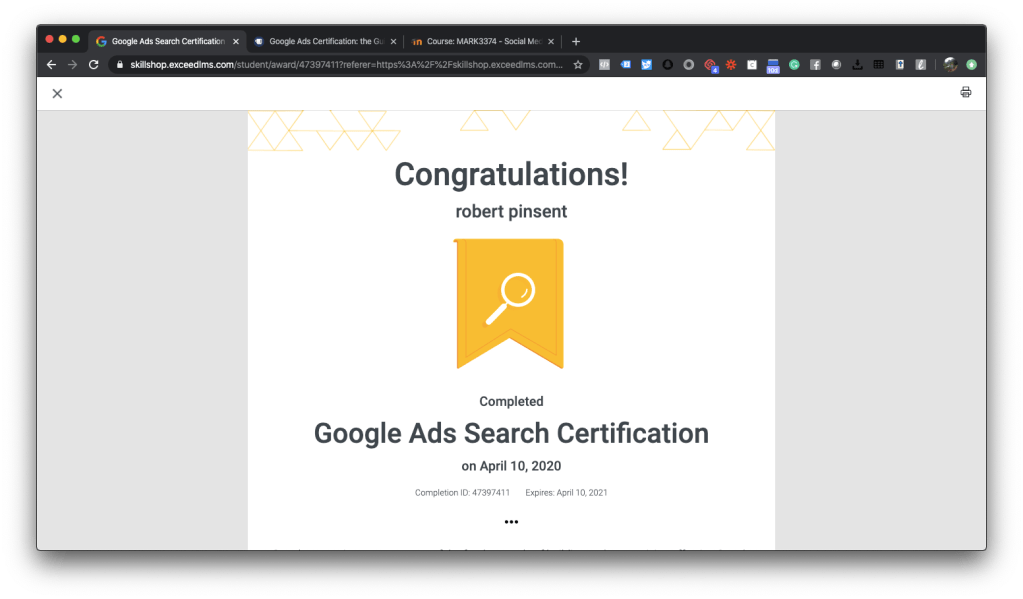
The Google Ads Search Certification has been a great tool to help me further develop a deeper understanding of the platforms advertising power and tools for marketers. I was able to take to the Google search ads exam and receive my certification and can now continue to advance my skills with Google and acquire more certifications.
References

Skillshop. (2019, September 7). Google Ads Search Certification. Retrieved April 10, 2020, from Google website: https://skillshop.exceedlms.com/student/path/18128-google-ads-search-certification

Categories
Uncategorized

Advertising on Facebook

Photo by Pixabay on Pexels.com

Advertising on facebook is an attractive

Categories
Uncategorized

Summary of Megan Adams Social CRM Course

In Megan Adams LinkedIn Learning social media marketing course, Social CRM, she takes her viewers through a journey of exploring the new and evolving practice of social CRM. As social media becomes a more intricate aspect of people’s lives, it’s become more important for organizations to begin to integrate this trend into their processes in order to stay competitive. Throughout the course, Adams delivers the ins and outs of effective social CRM.

Get Started

Social CRM is a strategy- supported by social media, online tools and technology, that enables organizations to better engage with customers (Adams, 2018). By adding social data points of customers to CRM, organizations enjoy many benefits that conventional CRM software cannot provide. Social CRM assists organizations in understanding their customers which ultimately creates more meaningful engagements and stronger brand advocates. By allowing customers to choose how they wish to interact with the organization, instead of building systems, the organization can collect more data and improve processes including: marketing, sales, customer service, support and experience.

When a company wants to begin leveraging social CRM, they’ll have many choices of software tool that could best meet their needs. Will it meet the size requirements for the organization, are the features easy and intuitive, does it integrate with our existing tools, what are the security and customer service features available, are all questions that need consideration. These, however, are just some of the considerations to review before making a decision (Adams, 2018). The successful adoption of social CRM requires organizations to first have “buy in” from their leadership and then allocate organizational resources such as time, money and manpower. Because of the technical nature of social CRM, organizations should expect to have to thoroughly train staff to develop their skills to be effective and provide sufficient ROI for the organization.

Photo by nappy on Pexels.com

Develop Your Strategy

One of the main purposes of social CRM is to have an effective brand strategy. Brand is the overall impression- resulting from communication and marketing methods -of a product or company that distinguishes itself from competitors (Adams, 2018). Companies want customers to think positively about them and spread that positivity throughout their network. Social CRM allows these companies to nurture their brand equity by removing the “faceless organization” with a more personal and humanized relationship. With new social tools available, it’s much easier for business and consumers to connect and foster relationships, although this also comes greater challenges and opportunities. Brands can be praised or tarnished quickly across platforms. Monitoring how customers feel and perceive an organization is critical to success.

Adams continues her training to elaborate some “rules of engagement” and how laying out clearly defined rules will set the standard for every prospect and customer interaction the organization has (Adams, 2018). Online engagement should be treated just like you would with a client or prospect face to face. People want to be respected, feel appreciated and have their concerns met quickly. Considering the fast speed of direct communication through social channels it’s in the organizations best interest to use for improving customer service and experience levels. Being proactive and solving problems quickly could be the competitive advantage that sets a company apart from their competitors. With good rules to follow, the organization should know how to deal with certain customer segments and personalize their communication and support.

Manage Social CRM

Managing an organization’s online social presence has many considerations. True influencers are people who drive action not just awareness (Adams, 2018). Leveraging bloggers or influencers with large audiences online are great to collaborate with and help promote the organization. When an influencer is relevant to an organization’s brand, a great partnership can form where everyone wins, and the organization attracts potential customers. Managing the relationship with these prospects should always begin with providing value. When value is provided upfront, trust and credibility is built, and a long-term relationship can develop which can eventually turn transactional. Once a customer is acquired, the usefulness of social CRM doesn’t stop. Social CRM allows for increased retention because it facilitates support in the customers preferred environment (Adams, 2018).  

Photo by Kaboompics .com on Pexels.com

Your Toolkit

When it comes to social CRM process documentation gives organizations the ability to systematize their social workflows of different business units. By having these processes documented, they can create a standard of customer experience and then allow incremental improvements over time. Collecting data is critical to understanding where these improvements can be made. Using analytics helps organizations to better understand the behaviors of their target audience and how to improve overall satisfaction and ultimately increase the lifetime value of that customer.  

Conclusion

Social CRM is a growing trend that can’t be ignored. As a small business owner, Adams presentation has brought insight into the importance of understanding the value of each customer and how the social data on them can improve their experience and sales. I’ve looked at the main software I use for my business and have discovered that it actually does collect social data on prospects that enter the system.

                                                            http://www.clickfunnels.com

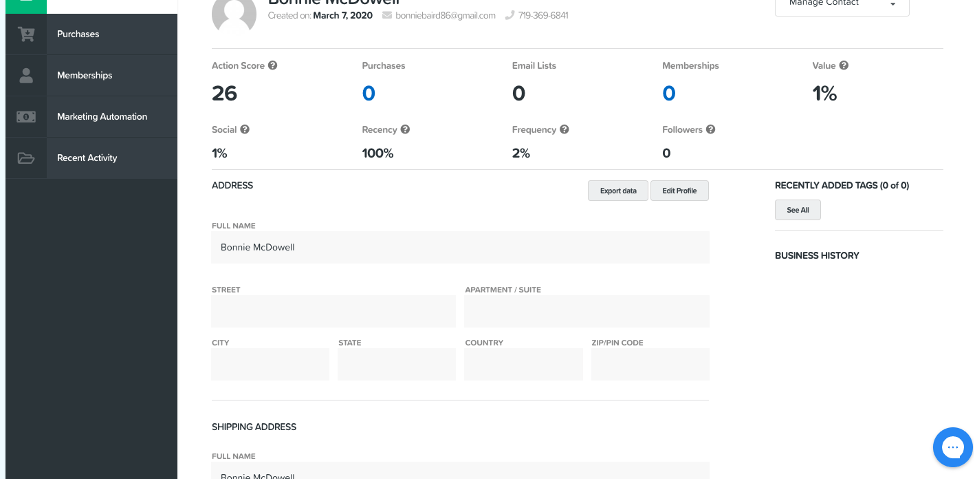
I wasn’t aware of this before but can now see that I have access to some social data on new prospects. For example, above you can see data on a new lead. This is showing a low overall social score which helps me determine the quality of the leas. I can determine from this lead that I wouldn’t spend as much time trying to convert this lead as compared to someone who scored higher.

References

Megan Adams. (2018, ) Social media marketing: Social CRM. Retrieved from      https://www.linkedin.com/learning/social-media-marketing-social- crm/welcome?u=2109516

http://www.clickfunnels.com

Categories
Uncategorized

Summary of Ian Luries Copywriting Course

I recently had the opportunity to go through Ian Luries’ LinkedIn Learning video course on copywriting. The course provides valuable insights on writing powerful marketing copy.

Overview of Marketing Copywriting

In these video tutorials, Ian Lurie begins by describing that he views copywriting as the “persuasive communication to get achieve desired outcomes from the readers or viewers” (Lurie, 2014). He describes that good copywriting includes writing that grabs attention, is a handshake with the viewer and is visually creative. He then mentions that to achieve the desired result through the CTA, the copy must deliver significance and a return on time invested to the targeted niche. 

Ian continues his lecture by describing how all copywriting consists of elements of three classes: collateral, medium and style (Lurie, 2014). Collateral consists of the building blocks that the message consists of, while the medium is the form of placement. Style is how that message is being delivered to the target audience. There are many forms of styles can can be effective to achieve a marketing objective. Teaching is a commonly used method aimed to educate the audience on the advantages of a product, however, their other methods such as straight sell, laughter, hard selling or the scare tactic also work effectively (Lurie,2014).

When writing marketing copy, following best practices such as blocking out time solely for writing, being free of distractions and keeping your workspace clean and organized will greatly assist in your overall effectiveness.

Writing Copy

The fundamentals of actually writing effective marketing copy begin with the software tools necessary to actually get the work done and avoid losses through backups. The importance of making a plan about the target audience and the types of collateral and style that will be most effective, can’t be understated. We learn that initially, getting all your thoughts down on paper by free-writing is an effective way to begin because it gets your creative ideas on paper which will set you up for success before moving onto your first draft. Here you can choose the style and collateral and will want to focus on writing the core of your marketing message first before the introduction or conclusion.

Lurie describes some general rules to follow as a copywriter including:

  • always address the reader,
  • quality writing is more important than quantity
  • sarcasm does not translate well and should be avoided
  • you should aim to demonstrate to the reader why they need what the marketer is selling and turn their need into a desire

With the rough draft complete, the next step is to move into polishing it by having a second set of eyes review and help with editing and proofreading. Some common pitfalls are “wordiness” in the writing that causes the reader to lose engagement.

Over the next few lessons we learn many more tips about structure that successful copywriting follows, beginning with the headline. It should be clear, concise and avoid any form of mysteriousness or fear mongering. They should also be A/B tested to see which preform best as they are the first thing the reader will see and is critical to catching and holding their attention. Finally, we learn about the structure of copywriting online. The specifics on number of words per line, lines per paragraph, line and paragraph spacing ratios, use of bullet pointed list, typography choices and sub-header use are all mentioned in how to create effective copy.

Rewriting Existing Copy

Lurie provides his views about the challenges of re-writing someone else’s copy and best practices. He states that you should not completely re-write the copy but instead focus on simple improvements without changing the structure. Re-writing is not ideal because you don’t know the audience as well as the original writer and it takes far more time. Instead focus should be placed on editing and seeking to removing “wordiness”.

There are differences with online copywriting which places heavy importance on readability. Because readers have a harder time reading long form copy online, we the copy needs to be broken down to shorter paragraphs with use of sub-headers. These principles apply as well to online product descriptions but should also include a clear CTA.

When it comes to copywriting for social media, Lurie states that things are a little different because of the social engagement of the posts. He mentions that best practice is to write like a conversation you would have with a friend. Sincere, kind, brief and enjoyable. He mentions that long form copy is not as effective and that posts should be paired with a relevant picture and non-stock photo to maximize effectiveness.

Conclusion

With a better understanding of effective marketing copy, I can now put my skills to the test in the market. By creating different versions of marketing copy in my Facebook ads, I can conduct A/B split testing to see which versions will resonate more with my target audience. For example, when I’m marketing to B2B clients, I can test an ad with the teaching method versus the scare method. Once I have a method that performs better, I can copy-write different versions using that method and then A/B test those copies to find a single message that truly resonates with my target market.

References

Lurie, I. (2014, May 30). LinkedIn Learning. Learning to write marketing copy. Retrieved from https://www.linkedin.com/learning/learning-to-write-marketing-copy/welcome?u=2109516

Berkley student learning centre. (n.d). Bloated language aka wordiness. Retrieved from https://slc.berkeley.edu/writing-worksheets-and-other-writing-resources/bloated-language-aka-wordiness

Categories
Uncategorized

Summary of Megan Adam Facebook Advertising Course

Facebook Advertising Overview

Megan Adams invites her viewers into the world of Facebook advertising to discover how incredibly powerful the tool can be for businesses. She begins by emphasising the importance of understanding your “why“ or purpose to leveraging the media platform for purchasing ads. After a quick example of how to recognize sponsored ads in your Facebook newsfeeds, we are then provided with a high-level overview of ads manager, which is Facebook’s platform that businesses use to create and manage their campaigns. 

Ads manager can initially seem overwhelming; however, Adams breaks the platform down systematically by first describing how anyone can create an account through their own personal Facebook profile as long as they have a business page to associate to the tool. You can then begin creating campaigns within the ads manager that is broken down into 3 levels: campaign, ad set and ad level. The campaign level is used to set the main objective of the ad is wishing to accomplish while the ad set level breaks down targeting. We discover how incredible powerful Facebook is when it comes to how advertisers can target specific audiences. Media buyers have the ability to target people geographically, demographically, by interest, behavior, as an uploaded audience list or even a custom audience tracked through a Facebook pixel. Adams also breaks down some metrics terminology that advertisers must understand to measure the performance of the campaigns including, CTRs, CPCs, CPM, Reach and Frequency

A screenshot of a cell phone

Description automatically generated

How Facebook Ads Work

In this next module of the training, Adams, describes how anyone with a personal profile can make create an ad account to begin advertising on Facebook. You can choose to run the ads from your personal ad account or create a separate account business account through business manager. To set up your account properly, you simply need to connect the account to your business page and provide a payment method. From here, you can adjust your settings for spend limits and your notification preferences. 

In order to create a powerful campaign, we learn that you must first understand how they are structured and how to create the appropriate framework settings. To begin, you first must choose a marketing objective through the campaign tab. Different objectives can help the business accomplish different things such as simple awareness or conversions like leads or purchases. Next, you can set your budget and choose a target audience in the ad set level. Facebook can get incredibly granular with its audience targeting making for a marketing paradise. Finally, in the ads level is where you can actually create the creative portion of ads your audience will view. You can choose to leverage videos, images to pair with your copywriting message.

How to Create Facebook Ads

Adams continues here tutorial through Facebook’s ads manager by going into the details of creating a campaign at the ad set level. Here we first learn how we can select and edit an audience type who we wish to target. Selecting an audience can be done by a variety of factors including by location, gender and age. To get an even more detailed audience, Facebook allows you to adjust the audience’s criteria to include specific interests and behaviors. This allows the marketer to really refine exactly who they wish to show their ads to. Adams gives us an example of this by showing available audiences who have an interest in the Los Angeles marathon and/or who also have a behavior of using Google Chrome. 

Once the audience is set, the media buyer will then be able to choose from a variety of placement. Options include on Facebook, Instagram, Messenger or Network Audience network. These all have multiple areas within each vehicle that can be selected to place the advertisement and can be viewed on desktop, mobile or both. The option to have Facebook automatically place the ads or to manually adjust the preferred placements are both available. The last section on the ad set level is the campaign budgeting which can have a daily spend allocated or a lifetime budget that Facebook will manage over a preselected timeline. 

The final level is the ad level settings. Here Adams walks us through the steps of creating the powerful ads we see on Facebook or Instagram. Ads can be either videos, single images or a carousel of images. Beyond the image or video there are several other aspects in the ad. These include the copywriting, the URL, a headline and description, CTA button and the advertising accounts Facebook pixel for event tracking. All these combine to provide the viewer with a powerful message of the business’s message and offer.

A screenshot of a cell phone

Description automatically generated

View Your Advertising Data

Once a business has their campaign running, they will want to be able to see how it’s performing. Adams shows us how Facebook has great reporting features that allow for just this. In the ad’s manger tab, the user can select “account overview” to see a variety of insights about their campaigns over any selected time period. Everything from total reach, ad spend, impressions, link clicks is available to get a macro understanding of the ad account. This also includes detailed demographic of the viewers, where they are from, and when they are viewing the ads. 

Within the campaign, ad set and ad levels a more detailed view of results is available. Here the advertiser can see the exact results metrics that Adams had referred to at the beginning of the training. Adams does not go into much detail about the metrics but emphasises that measuring success “isn’t as simple as pulling a single metric” (Adams, 2019) The campaign results can also be documented by available reports. Facebook does provide standard reports that can be downloads and reviewed in a excel or csv file, or alternatively, a custom report can be created within ads manager to include and combination of specific metrics that the advertiser wishes to include. 

Implement Best Practices

To achieve success with advertising on Facebook, Adams provides some of her best practices to follow. These include ensuring that all copy and creative work is relevant to the targeted audience including off Facebook and onto a landing page. For ads to perform their best, each portion of the ad should resonate with who it’s designed for, while feeling natural and eye catching. Once the ads are created, the work is not over. Ads should be analyzed and tested against others to optimize their performance. If done correctly, only strong winning ads should remain that resonate deeply with the targeted audience. 

Conclusion

Throughout the video tutorials, Megan Adams provided a clear and detailed understanding of how powerful Facebooks ads can be and the arsenal of tools within its ad’s manager platform. I was very interested in each module and found the flow of the teaching very clear and easy to grasp. After completing the course, I believe anyone could have an understanding of what is required to use the platform effectively at a basic level. 

With a deeper understanding of the platform and creative effective ads, I am able to analyze specific ads that show up in my newsfeed and determine if they follow the best practices as outlined in the training. As an example, I can analyze this ad here:

A screenshot of a social media post

Description automatically generated

When reviewing this ad, we can first notice it is, in fact, an ad because it has the “sponsored” tab. The ad is also likely targeted to me because I’ve been researching Facebook ads and my behavior online has been picked up by this companies Facebook pixel. The advertisement uses the interesting tagline “GET OUT OF JAIL FREE” in the copy to initially catch my attention. They also have a clear CTA button to apply for their offer and a second link to their URL in the copywriting. All of these demonstrate that this advertisement is being published by a sophisticated marketer with experience in effective Facebook ads. Something I may not have recognized without the course from Megan Adams.

References 

Adams, M. (2019, October 2). Facebook is an advertiser’s dream. Retrieved from https://www.linkedin.com/learning/advertising-on-facebook-2/facebook-is-an-advertiser-s-dream?u=2109516Open publish panel

Categories
Uncategorized

Summary of Oliver Schinkten’s LinkedIn Learning For Students

Create a LinkedIn Profile

With over 500 million members, 9 million companies and 10 million job postings, LinkedIn is an incredibly powerful tool for both students and working professionals.  In his video lessons, Oliver Schinkten walks us through the fundamentals of setting up a professional and strong LinkedIn profile. He begins by emphasising the importance of your profile picture and headline as that is the very first thing people see when they search for you and will provide them with a snapshot of who you are and the message you want to reflect. From here, LinkedIn has several more subsections to fill out that provide viewers with a more insight on who you are. These include a summary of who you are and what you are passionate about, your work history, education level, as well as any special skills that you possess. These sections allow viewers to get a better understanding of what you offer and the value that you bring to the market. 

Schinkten continues by providing smart tips on the details of setting up a strong profile. We learn that by having 5 or more skills listed, your profile is “27 times more likely to show up in search results” (Schinkten, 2018). He also recommends leveraging your past working relationships through the form of endorsements and profile posted recommendations. These will help add to the strength of your profile and improve the likelihood of overall success. 

Build Your Network

“Two of the most popular ways companies find new hires are through employee referrals and social professional networks” (Schinkten, 2018). This highlights the importance for LinkedIn users to have a strong profile and professional network. Schinkten describes the strategies behind growing your personal network and adding connections on the platform. There are three types of connections you should have: advocates who promote you, strategic ins who are well connected in the industry you are in and finally subject matter experts who you can learn from. By having these types of connections, you are able to form a “win win” (Schinkten, 2018) relationship where you each provide each other with a certain level of value. Best practices include sending someone a message with your connection request and the reason for connecting. 

LinkedIn has a powerful search tool that allows you to find and filter connections at a very granular level. You can search by people, job, content, groups, schools or use the Boolean modifier function to set specific and/or searches. Another function to find connections of interest is through the Alumni tool that helps find alumni of your school or through LinkedIn groups where people of shared interest congregate.

Using LinkedIn Day-to-Day

LinkedIn is very similar to other social network platforms in terms of its day to day functionality. You can make connections, follow different companies and influencers, send and receive messages as well as publish your own content for your network and other users to view and engage in. While using these functions on LinkedIn, you want to be mindful of the digital footprint that you leave behind. Your digital footprint is “essentially your own personal brand” (Schinkten, 2018). This is incredibly important as the majority of employers will search potential candidates on LinkedIn and their digital footprint will influence them in their decision. Those with profiles that reference poor quality traits will be viewed negatively, while those with good will be favourable. I believe that by completing courses through LinkedIn Learning shows prospective employers that you have the desirable attitude towards personal development and growth.

Job Search and Company Research

When searching for a new job, LinkedIn is a very valuable resource. Schinkten walks us through the assortment of features that LinkedIn makes available for job searching including its powerful search engine. Again, similar to how to find connections, you can search for specific job postings and add layers of filters to find the exact type of job you are looking for. You can also search companies directly and find any postings and analytics directly on their page. Once you’ve found a job posting that is of interest, you can apply for that job directly from LinkedIn. Job alerts are also available to send the user notifications when jobs are posted that meet their set of filters. 

Manage Your LinkedIn Account

Schinkten concludes his video course by demonstrating some best practices in managing your profile. First, he encourages his audience to consider using the Premium version of LinkedIn. This version has some beneficial features that are not available with the standard free account. These include company insights, the ability to send in-mail and to move up on job applications. Depending on your specific goals, premium may be worth the investment.  He next, suggests taking a detailed look at your setting and managing them correctly. You may not wish to have your network updated on profile updates or have them know if you’ve viewed their profile or not. By checking these settings regularly, ensures that you are aligned with your desired digital footprint. 

Conclusion

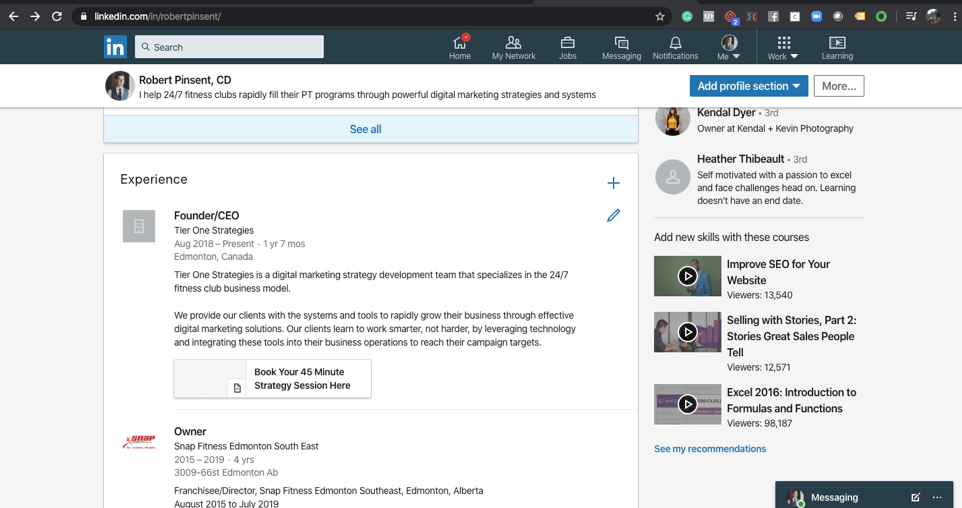
One of the key takeaways I’ve taken from Oliver Schinkten’s course was the need to add more details into my profile. This is important for anyone who I wish to do business with so they can have a better understanding of what the company does and how to get connected with us more easily. This is my profile before: 

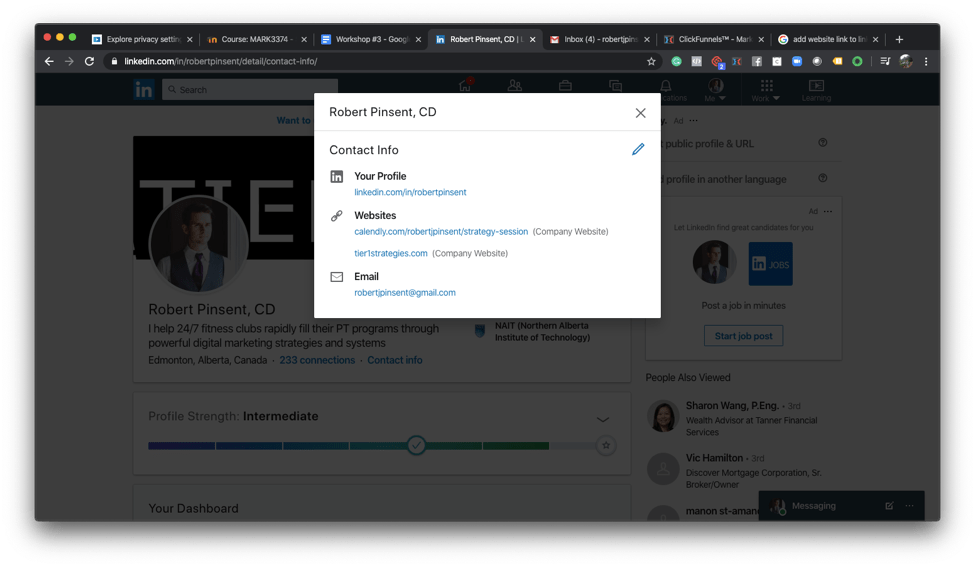
After review, I’ve decided that more information in the experience tab was needed so I’ve added more details about my company and what we do. I’ve also changed the URL from just our booking calendar integration to adding our website URL. This will allow viewers of my profile to view to be able to continue directly to the website if they wish to learn more about our services where they will be able to book a strategy session anyways.

A screenshot of a computer

Description automatically generated

References


Schinkten, O. (2018, October 18) Learning LinkedIn for students. [Video course] Retrieved from https://www.linkedin.com

Design a site like this with WordPress.com
Get started